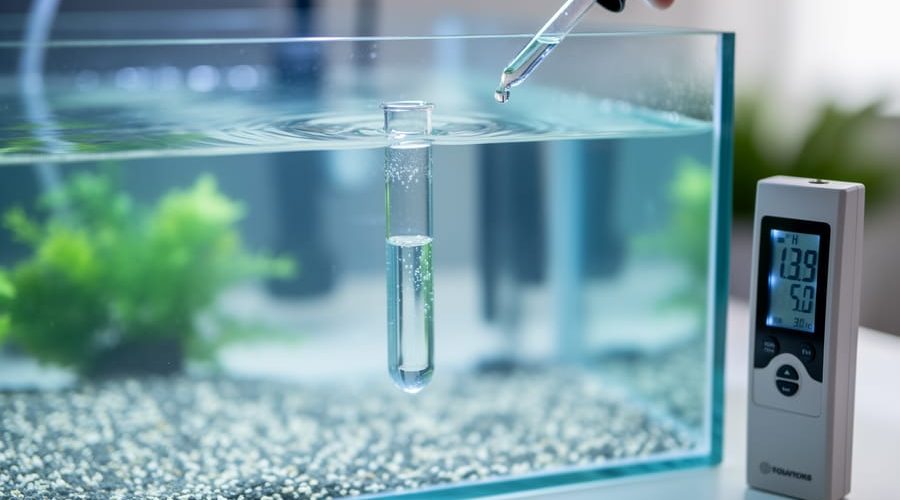
Testing your aquarium’s pH level takes less than five minutes using a liquid test kit or digital meter, and it’s the single most important water quality check you can perform to keep your fish healthy. Most freshwater aquariums thrive between 6.5 and 7.5 pH, while saltwater tanks need 8.0 to 8.4, but the stability of that number matters even more than hitting a perfect target.
Your fish evolved in specific water conditions, and sudden pH swings cause stress, suppress immune systems, and can trigger disease outbreaks faster than any other water quality issue. The challenge is that pH shifts invisibly throughout the day as plants photosynthesize, fish respire, and biological filtration cycles ammonia and nitrates. Without regular testing, you’re navigating blind.
This guide walks you through the complete testing process, from choosing between liquid reagent kits and digital testers to interpreting color charts under proper lighting and verifying questionable readings. You’ll learn what drives pH changes in closed aquatic systems, how to troubleshoot common testing errors, and when your results signal the need for immediate action versus gradual adjustments. Whether you’re cycling a new 10-gallon betta tank or maintaining a 200-gallon reef system, mastering pH testing gives you the foundational skill that supports every other aspect of water quality management.
Why Aquarium pH Matters for Fish Health
pH measures how acidic or alkaline your aquarium water is on a scale from 0 to 14, with 7 being neutral. Most freshwater fish thrive between 6.5 and 7.5, while saltwater pH ranges typically sit higher at 8.0 to 8.4. These numbers might seem abstract, but they directly affect your fish’s ability to breathe, digest food, and fight off disease.
When pH strays outside your fish species’ preferred range, their gills struggle to regulate oxygen and salt exchange across cell membranes. A tank that’s too acidic (low pH) can burn gill tissue and slow metabolism, while overly alkaline water (high pH) causes ammonia to become more toxic and interferes with nutrient absorption. You’ll notice stressed fish gasping at the surface, hiding constantly, or displaying faded colors.
The ecosystem balance in your tank depends on stable pH because beneficial bacteria that break down waste function best within specific ranges. Rapid pH fluctuations, even within safe limits, shock fish systems more than a steady pH that’s slightly off-target. Your fish evolved to handle gradual changes in their natural habitats, but captive environments can shift quickly without proper monitoring. That’s why regular testing catches problems before they escalate into health crises.
What You’ll Need to Test pH
Testing your aquarium’s pH requires just a few basic supplies, most of which you probably already have around the house. The most important item is a reliable pH test kit, and you’ll want to choose the right type for your experience level and budget.
There are three main options when selecting an aquarium test kit for pH measurement. Liquid reagent kits are the gold standard for accuracy, you add drops of a chemical solution to a water sample and compare the resulting color to a chart. These typically cost between $8 and $15, last for 100-200 tests, and provide precise readings within 0.2 pH units. Test strips offer convenience: you dip the strip in tank water, wait 30-60 seconds, and match the color. They’re faster but less accurate, with readings within 0.5 pH units, and cost about $10 for 50 strips. Digital pH meters give instant numerical readings and are favored by serious hobbyists, but they require calibration solutions and regular maintenance, with decent models starting around $30.
Beyond the test kit itself, you’ll need a few supporting items:
- Clean container or test tube for water samples (often included with liquid kits)
- Timer or phone to track reaction times accurately
- Notebook or app for logging test results and dates
- Distilled water for rinsing equipment between tests
- Calibration solutions if using a digital meter (pH 4.0 and 7.0 buffers)
For beginners, a liquid reagent kit strikes the best balance between accuracy, ease of use, and cost. You’ll get consistent results without the calibration hassles of digital meters or the imprecision of strips. Advanced hobbyists managing multiple tanks or breeding sensitive species often prefer digital meters for speed and recordkeeping, despite the higher upfront investment.
Before You Test: Safety and Preparation Tips
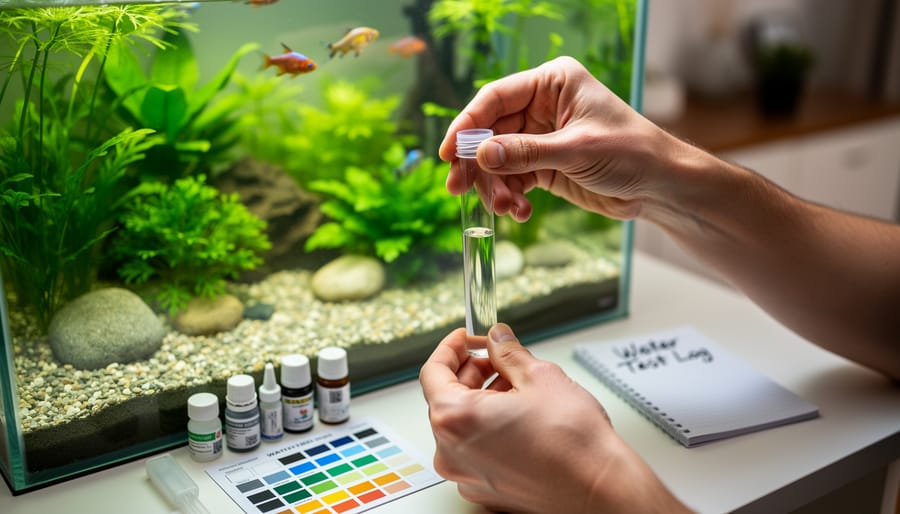
Before you start testing, take a few safety precautions to protect yourself and your household. Most pH test reagents contain mild chemicals that can irritate skin and eyes, so avoid direct contact with the liquids. If you do get reagent on your skin, rinse immediately with clean water. Store all test kit components in their original containers, tightly sealed, and keep them well out of reach of children and pets, even small amounts of these chemicals can be harmful if swallowed.
Now for preparation. Test your aquarium pH at the same time each day for consistent results, early morning works well because pH naturally fluctuates throughout the day as fish respire and plants photosynthesize. Before collecting your water sample, make sure your hands are clean and free of soap, lotion, or other contaminants that could skew results. Use a clean container that hasn’t held any chemicals or cleaning products. If you’re testing multiple tanks, rinse your collection container with tank water between tests to prevent cross-contamination. Finally, have your notebook ready to record the date, time, and result, tracking pH over time helps you spot trends and catch problems early.
Step-by-Step: How to Test Aquarium pH
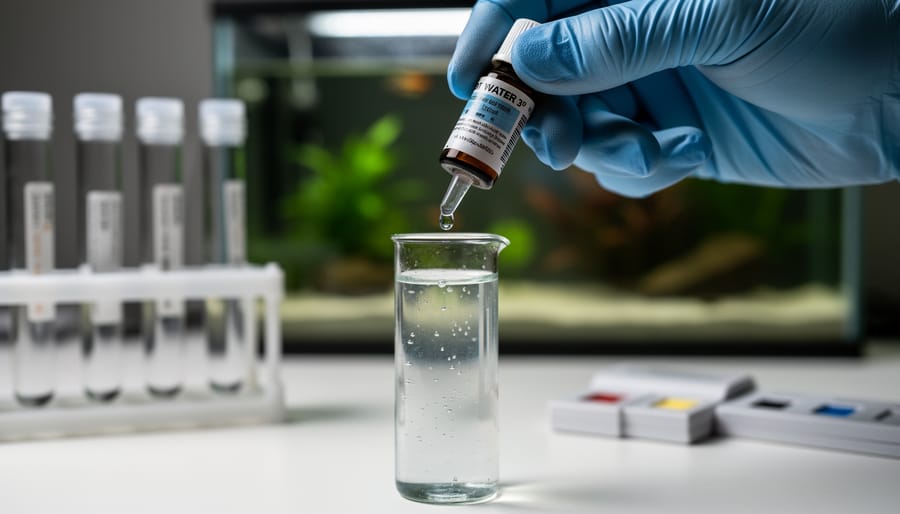
Using Liquid Test Kits
Fill a clean test tube to the marked line with aquarium water from mid-tank depth, avoid surface film or substrate debris. Hold the reagent bottle vertically and add the exact number of drops specified in your kit instructions, typically 3-5 drops. Count carefully; an extra drop throws off the reading.
Cap the tube tightly and shake for 5-10 seconds. Some kits require gentle swirling instead of vigorous shaking, check your instructions. Set the tube on a white surface under natural or bright white light. Artificial yellow lighting distorts color perception.
Wait the recommended time, usually 5 minutes. The water will change color as the reagent reacts with dissolved substances. Hold the color chart directly behind the tube at eye level. Match the water color to the chart’s closest shade, don’t tilt your head or view at an angle. If the color falls between two values, record it as the midpoint.
Rinse the test tube immediately after reading. Dried reagent residue contaminates future tests and makes the tube cloudy, affecting color accuracy.
Using Test Strips and Digital Meters
Test strips offer the fastest option, dip one into your tank water, wait 15-30 seconds, then read test strips by matching the color pad against the chart on the bottle. They’re convenient for quick checks and cost about $8-15 for 50 strips, but accuracy can vary by 0.2-0.5 pH units. Strips work well for routine monitoring when you already know your tank’s baseline.
Digital pH meters give the most precise readings (accurate to 0.01 pH units) and eliminate color-matching guesswork. Simply rinse the probe, insert it into your tank water, and read the digital display within seconds. Quality meters start around $30-50 but require regular calibration with buffer solutions every few weeks and careful probe maintenance. They’re ideal for breeders, planted tanks with CO2 injection, or anyone keeping fish with strict pH requirements. The trade-off: higher upfront cost and ongoing calibration needs versus the simplicity and one-time purchase of liquid test kits.
Reading and Understanding Your pH Results
Once your test completes, you’ll need to decode what the color or number tells you about your tank’s health. If you used a liquid test kit, hold your sample tube against the color chart in bright, natural light, artificial lighting can distort color matching. Find the closest color match; pH readings typically fall somewhere between 6.0 and 8.5 for most freshwater aquariums. The pH scale runs from 0 (extremely acidic) to 14 (extremely alkaline), with 7 representing neutral, the same as pure water.
For digital meters, simply read the number displayed. Cross-reference your result with your fish species’ preferred range. Most community fish thrive between 6.5 and 7.5, while African cichlids prefer 7.8 to 8.6, and discus or tetras do best around 6.0 to 6.8. A reading within your species’ target range means your water chemistry is stable.
Natural pH fluctuations of 0.2 to 0.3 units over 24 hours are normal, caused by photosynthesis during daylight and respiration at night. Problematic swings show changes of 0.5 units or more between tests, or readings drifting steadily outside your target range over days. These signal underlying issues like inadequate buffering capacity, decaying organic matter, or substrate leaching minerals.
If your pH sits outside the ideal range but remains stable, don’t panic. Many fish adapt to consistent conditions better than they tolerate rapid corrections. Record your result with the date and time, and consider testing other parameters with a TDS meter to understand your overall water quality before making adjustments.
Verifying Accuracy and Next Steps
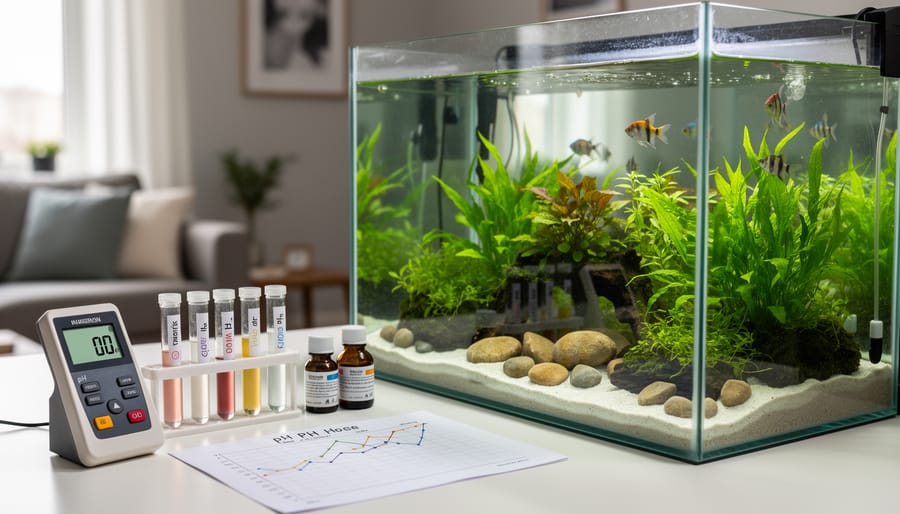
Your first reading might not tell the whole story. Even the best test kits can produce odd results if reagents are old, water samples are contaminated, or you misread the color chart in dim lighting.
Start by retesting the same water sample immediately. If you get a different reading the second time, the first was likely user error. Next, test your tap water before any conditioner treatment as a baseline reference. Most municipal water supplies publish their water quality reports online, giving you a known pH value to compare against. If your tap water tests at 7.2 and the city reports 7.3, your kit is working properly.
Cross-checking with a different test method adds confidence. If your liquid kit shows 6.8, grab test strips or borrow a digital meter to verify. Consistent readings across methods mean you can trust the result. Wildly different numbers suggest one kit has expired reagents or calibration issues.
For ongoing monitoring, test pH weekly during the first month of a new tank, then every two weeks once conditions stabilize. Always test at the same time of day since pH naturally fluctuates with plant photosynthesis and fish respiration cycles. Test more frequently if you notice stressed fish, after adding new livestock, or when treating diseases.
When pH falls outside your fish species’ ideal range, resist the urge to fix it immediately. Here’s your decision framework:
- Mild deviation (0.2-0.3 units): Monitor daily for three days to confirm it’s not a temporary spike
- Moderate concern (0.4-0.6 units): Begin gradual adjustments through increased water changes over one week
- Critical levels (0.7+ units or below 6.0/above 8.5): Consider temporary quarantine and consult experienced aquarists
- Readings that contradict fish behavior: Retest with fresh reagents before taking action
The safest first response is always a 25% water change with properly conditioned, temperature-matched water. This dilutes whatever caused the shift without shocking your fish. Wait 24 hours, retest, then decide if you need the targeted fixes covered in the next section.
Common pH Problems and Quick Fixes
If your test shows pH outside your fish’s ideal range, resist the urge to dump in chemicals immediately. Rapid pH swings stress fish far more than a stable reading that’s slightly off target.
When pH is Too High (Above 8.0 for Most Freshwater Fish)
High pH typically stems from alkaline tap water, limestone-based decorations, or crushed coral substrates. Start with regular partial water changes, 20-30% weekly using conditioned water. If your tap water is also alkaline, let it sit in a bucket with driftwood for 24 hours before adding it to the tank. Malaysian driftwood and mopani wood naturally release tannins that lower pH gradually over weeks.
For faster results without chemicals, add Indian almond leaves or alder cones. These botanical additions work slowly, preventing shock while creating a more natural blackwater environment many fish prefer. Remove any decorations made of shells, coral, or limestone that continuously leach minerals and push pH upward.
When pH is Too Low (Below 6.5 for Most Community Tanks)
Acidic conditions often develop from decomposing organic matter, CO2 buildup from poor aeration, or naturally soft water. Increase surface agitation with your filter output or add an air stone to drive off excess carbon dioxide, which can drop pH by half a point or more.
Crushed coral placed in a mesh bag inside your filter provides long-term buffering, slowly dissolving to raise pH as needed. Limestone rocks offer similar benefits. These natural calcium carbonate sources work gradually and stop dissolving once pH stabilizes, making them safer than liquid buffers.
The Golden Rule
Never adjust pH more than 0.2 points per day. If you’re at 6.2 and need 7.0, plan for a two-week gradual shift. Remove fish to a hospital tank only if pH drops below 5.5 or rises above 9.0, true emergencies. Most species adapt to stable “wrong” pH better than fluctuating “correct” levels.
Chemical pH adjusters work but require constant monitoring and reapplication. Natural methods self-regulate, align with eco-friendly aquarium keeping, and address underlying water quality issues rather than masking symptoms.
Frequently Asked Questions
Testing your aquarium’s pH regularly raises practical questions. Here are answers to help you establish an effective testing routine and troubleshoot common issues.
How often should I test my aquarium’s pH?
Test pH weekly in established tanks with stable conditions. New tanks or those experiencing fish stress require daily testing until stability is achieved. After water changes or adding new livestock, retest within 24 hours to confirm parameters remain stable.
Should I test pH before or after water changes?
Test both before and after water changes to understand how your tap water affects tank pH. Testing beforehand establishes your baseline, while testing 30 minutes after a change reveals any pH swings that might stress your fish.
Why does my tap water pH differ from my tank pH?
Tank pH naturally differs from tap water due to biological processes, substrate materials, decorations like driftwood or coral, and dissolved carbon dioxide from fish respiration. This is normal and expected as your aquarium develops its own ecosystem.
Do pH test kits need calibration?
Liquid reagent kits and test strips do not require calibration, but they do expire and lose accuracy over time. Digital pH meters need calibration with buffer solutions every few weeks and before first use to maintain accuracy.
If you get inconsistent readings, check that your test kit has not passed its expiration date and that reagents have been stored properly away from heat and light. Shake liquid reagent bottles vigorously before use, as settled chemicals produce inaccurate results. When using test strips, ensure your hands are completely dry before handling them, since moisture causes false readings even before you dip the strip.
For digital meters showing erratic numbers, replace the probe or recalibrate with fresh buffer solutions. Always rinse probes with distilled water between tests to prevent contamination. If multiple test methods give you different results, trust the liquid reagent kit as your baseline, since these typically offer the most reliable measurements for home aquarium use.
Testing your aquarium’s pH takes just five minutes, but those few minutes protect weeks or months of careful fishkeeping work. You’ve learned that a simple liquid test kit, test strip, or digital meter can tell you whether your fish are living in conditions that support their health or stress their systems. Regular testing isn’t busywork, it’s preventive care that catches problems before they harm your aquatic community.
Make pH testing part of your weekly routine alongside checking ammonia, nitrites, and nitrates. This complete water quality picture helps you spot patterns, understand your tank’s unique chemistry, and respond before fish show distress. When you maintain stable pH levels through gradual adjustments and proper monitoring, you create an environment where fish thrive naturally, reducing your need for emergency interventions and chemical corrections.
The five minutes you spend testing today save hours of troubleshooting later. Start your testing routine this week, keep a simple log of your readings, and watch how consistent monitoring transforms your approach to aquarium care. Your fish can’t tell you when something’s wrong with the water, but your pH test kit can.