When harmful emerging contaminants like pharmaceuticals, pesticides, and industrial compounds slip through conventional water filters, NSF/ANSI Standard 401 provides the benchmark you need to protect your family. This certification identifies water treatment systems that successfully reduce 15 specific “incidental contaminants”—substances increasingly detected in tap water that weren’t addressed by older testing standards.
Check your current water filter or any prospective purchase for the NSF/ANSI 401 certification mark, which guarantees the system removes at least 85% of tested contaminants including prescription drugs like ibuprofen and hormones, herbicides such as glyphosate, and flame retardants like TCEP. Unlike Standard 53 (which covers heavy metals and cysts) or Standard 42 (focused on taste and odor), Standard 401 specifically targets modern pollutants entering water supplies through agricultural runoff, pharmaceutical waste, and industrial discharge.
Verify certification authenticity by visiting NSF International’s online database rather than relying solely on packaging claims—some manufacturers misrepresent their products’ capabilities. Look for systems combining multiple certifications (401, 53, and 42) to address the broadest spectrum of water quality concerns.
Understanding this standard empowers you to make informed decisions about your household water treatment, especially if you live near agricultural areas, pharmaceutical manufacturing sites, or urban centers where these emerging contaminants concentrate. The certification represents cutting-edge water safety innovation, transforming how we approach home filtration in an era of increasingly complex water contamination challenges.
What Exactly Is NSF/ANSI Standard 401?
NSF/ANSI Standard 401 represents a groundbreaking development in water quality certification, specifically designed to address the modern contaminants that older standards weren’t created to handle. Introduced in 2018 by NSF International—the same independent organization behind NSF/ANSI Standard 53 and NSF/ANSI Standard 61—this certification focuses on what scientists call “incidental contaminants” or “emerging compounds.”
Think of it this way: traditional water quality standards were developed decades ago when the primary concerns were heavy metals like lead, chlorine, and common bacteria. While those contaminants remain important, our modern world has introduced entirely new substances into our water supply that previous standards simply didn’t account for.
Standard 401 specifically targets 15 concerning contaminants that have become increasingly prevalent in drinking water. These include prescription medications that enter water systems through human waste, over-the-counter drugs like ibuprofen, hormone disruptors from plastics and personal care products, and industrial chemicals such as certain herbicides and flame retardants.
The key difference is focus and intent. While earlier NSF standards concentrated on removing traditional pollutants that posed known health risks, Standard 401 addresses substances that researchers are still studying for their long-term health effects. Many of these emerging contaminants exist in trace amounts—measured in parts per billion or even trillion—but their accumulation over time raises legitimate concerns among scientists and health professionals.
For homeowners committed to eco-friendly living and cutting-edge water safety, understanding Standard 401 means staying ahead of water quality issues rather than simply reacting to well-known problems from the past.
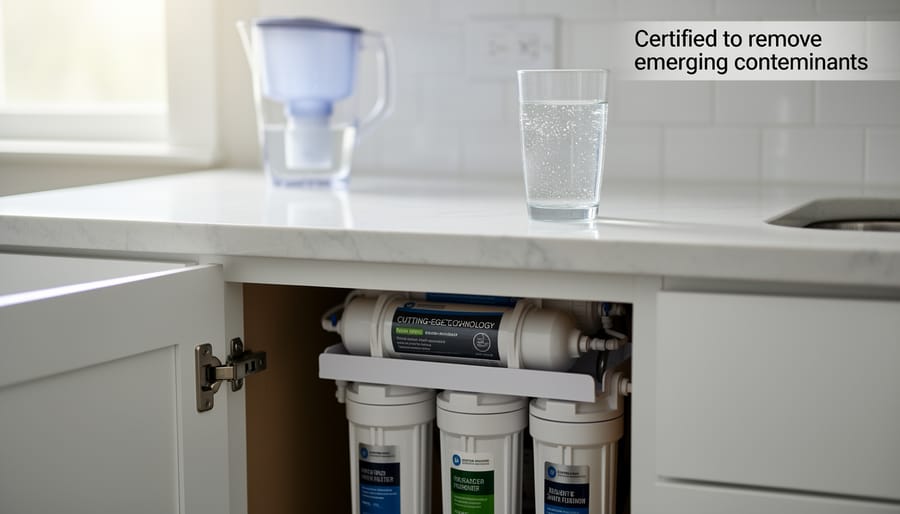
The Emerging Contaminants Standard 401 Tests For
Prescription and Over-the-Counter Medications
Every day, trace amounts of pharmaceuticals find their way into our water supply through a surprisingly common route: our own homes. When we take medications like ibuprofen, antibiotics, or hormonal contraceptives, our bodies don’t absorb everything. The remainder passes through our system and enters wastewater. Additionally, many people flush unused medications down the toilet, directly introducing these compounds into the water cycle.
Municipal wastewater treatment plants weren’t originally designed to remove these pharmaceutical contaminants, which means they often pass through unchanged and eventually reach rivers, lakes, and groundwater sources. Even tiny concentrations measured in parts per billion can potentially affect aquatic ecosystems and may pose unknown long-term health effects for humans.
This is where NSF/ANSI Standard 401 becomes important for your home. The standard specifically tests water filters for their ability to remove 15 common pharmaceutical compounds, including hormones like estrone and progesterone, pain relievers such as ibuprofen and naproxen, and various prescription medications. By choosing a water treatment system certified to this standard, you’re taking a proactive step to protect your family from these emerging contaminants that traditional municipal treatment may miss.
Industrial Chemicals and Flame Retardants
Modern industrial production has introduced thousands of chemical compounds into our environment, and many of these substances eventually find their way into our water supply. NSF/ANSI Standard 401 specifically addresses several industrial chemicals that weren’t traditionally monitored in drinking water but are now recognized as potential health concerns.
Among the most notable contaminants in this category is PFOA (perfluorooctanoic acid), a synthetic chemical once widely used in non-stick cookware and water-resistant fabrics. Often called a “forever chemical,” PFOA doesn’t break down naturally and can accumulate in the human body over time. Similarly, BPA (bisphenol A), commonly found in plastics and food can linings, has raised concerns due to its hormone-disrupting properties.
The standard also covers other industrial compounds like certain flame retardants that were added to furniture, electronics, and building materials for fire safety. While these chemicals served important purposes in manufacturing, research has revealed their persistence in the environment and potential health impacts.
For homeowners concerned about these invisible threats, filters certified to Standard 401 provide meaningful protection. These systems are specifically tested to reduce these industrial contaminants to safer levels, offering peace of mind that goes beyond basic filtration. This represents a significant advancement in home water treatment, addressing emerging contaminants that older standards simply weren’t designed to catch.
Herbicides and Pesticides
Agricultural chemicals routinely make their way into drinking water through farm runoff and residential use. NSF/ANSI Standard 401 specifically tests filters for their ability to remove herbicides like glyphosate, one of the world’s most widely used weed killers, and 2,4-D, another common agricultural herbicide. The standard also covers DEET, the active ingredient in many insect repellents that enters water systems through personal care product use and outdoor applications. These chemicals can persist in groundwater and surface water for extended periods, potentially reaching your tap. While conventional water treatment plants weren’t originally designed to remove these modern contaminants, filters certified to Standard 401 have been independently tested to reduce them to safer levels. For homeowners near agricultural areas or those using well water, choosing a filtration system that addresses these specific chemicals provides an extra layer of protection for your household.
How Standard 401 Certification Actually Works
Getting certified under NSF/ANSI Standard 401 isn’t a simple checkbox exercise. It’s a rigorous process that sets this certification apart from basic water safety testing standards.
Here’s how the certification process works: independent testing laboratories accredited by NSF International take water treatment products through extensive evaluation protocols. These labs introduce precise concentrations of the 15 emerging contaminants into test water, then measure how effectively the filter removes each one. To pass, a product must reduce each contaminant by at least 90 percent, though many certified systems achieve removal rates exceeding 95 percent.
The testing doesn’t stop after initial certification either. Manufacturers must submit to regular unannounced inspections and annual retesting to maintain their Standard 401 status. This ongoing verification ensures that the filter you buy today performs just as well as the one that originally earned certification.
What makes this particularly meaningful for you as a consumer is the third-party verification aspect. Unlike manufacturer claims that may sound impressive but lack independent validation, Standard 401 certification means an outside organization has verified the product’s performance. The testing uses actual emerging contaminants at realistic concentrations you might encounter in drinking water, not hypothetical scenarios.
When you see the NSF/ANSI Standard 401 mark on a water filter, it tells you several important things. First, the product has been tested against specific emerging contaminants that other certifications don’t address. Second, it meets strict reduction requirements for each individual contaminant, not just general categories. Third, the manufacturer has committed to ongoing quality control and periodic retesting.
This certification ultimately gives you confidence that your investment in cleaner water is backed by science and independent verification. It removes the guesswork from choosing a water treatment system designed to protect your household from modern contaminants that conventional filters might miss.
Why Your Current Water Filter Might Not Be Enough
If you’ve been relying on a water filter for years, you might assume you’re well protected from harmful contaminants. However, many older filtration systems only address the basics—sediment, chlorine taste and odor, and perhaps some heavy metals. While these traditional filtration standards like NSF/ANSI 42 and 53 are important, they weren’t designed to tackle the emerging contaminants we face today.
The water quality landscape has changed dramatically over the past few decades. Pharmaceuticals from medications that pass through our bodies, herbicides and pesticides from agricultural runoff, and industrial chemicals like BPA have become widespread in water supplies. These substances often pass right through conventional filters because the technology wasn’t built with them in mind.
Here’s the key difference: Standard 401 certification specifically tests a filter’s ability to remove 15 emerging contaminants that weren’t even on our radar when older standards were developed. This includes prescription medications like ibuprofen and estrogen, weed killers like glyphosate, and flame retardants found in household products. These contaminants can be present in trace amounts—parts per billion—but their long-term health effects are still being studied, making their removal increasingly important.
Think of it this way: your current filter might be excellent at making water taste better and removing visible particles, but it could be missing invisible threats that require more advanced filtration technology. NSF/ANSI Standard 401 represents the next generation of water safety, addressing the complex chemical landscape of modern water contamination.
Which Water Treatment Systems Can Achieve Standard 401 Compliance
Reverse Osmosis Systems
Reverse osmosis (RO) systems represent the gold standard for removing Standard 401 contaminants from your drinking water. These advanced filtration systems work by forcing water through an incredibly fine membrane that blocks particles as small as 0.0001 microns—effectively capturing pharmaceuticals, pesticides, herbicides, and most emerging contaminants that other filters might miss.
What makes RO particularly effective is its multi-stage approach. Water passes through pre-filters, the RO membrane, and often a carbon post-filter, ensuring comprehensive removal of both Standard 401 contaminants and those covered by NSF/ANSI Standard 177. Independent testing shows that certified RO systems can remove 95-99% of the contaminants addressed in Standard 401.
For homeowners, it’s important to verify that your RO system specifically holds Standard 401 certification rather than just general NSF certification. While RO systems do produce some wastewater during filtration, newer eco-friendly models have significantly improved water efficiency. Regular membrane replacement—typically every 2-3 years—ensures optimal performance in protecting your family from these concerning emerging contaminants.
Advanced Carbon Block Filters
Advanced carbon block filters represent one of the most effective technologies for achieving NSF/ANSI Standard 401 certification. These filters work by forcing water through densely compacted activated carbon, which traps contaminants through a combination of mechanical filtration and chemical adsorption. The carbon’s porous structure provides an enormous surface area—often equivalent to several football fields in just one filter—where emerging contaminants like pharmaceuticals, pesticides, and flame retardants can bind and be removed from your drinking water.
What makes carbon block filters particularly suited for Standard 401 compliance is their ability to maintain prolonged contact time between water and the carbon medium. Unlike looser granular carbon, the tight compression of carbon block technology ensures water moves slowly enough for thorough contaminant reduction. Many certified systems combine multiple stages, pairing carbon filtration with other technologies to target the 15 specific contaminants outlined in the standard. When shopping for a filter, look for products explicitly listing Standard 401 certification rather than general carbon filtration claims, as not all carbon filters meet these rigorous requirements.
Whole House vs. Point-of-Use Solutions
When choosing NSF/ANSI Standard 401 certified filtration, you’ll need to decide between whole house systems and point-of-use solutions like under-sink or faucet-mounted filters. Each approach offers distinct advantages depending on your household needs and budget.
Whole house systems treat all water entering your home, providing comprehensive protection at every tap, shower, and appliance. These systems represent a significant upfront investment but deliver complete peace of mind for families concerned about emerging contaminants in their bathing and cooking water.
Point-of-use options, particularly under-sink filters, offer a more affordable entry point while still delivering Standard 401 protection where you need it most—at your drinking water tap. These compact solutions are easier to install and maintain, making them popular among environmentally-conscious homeowners just starting their water quality journey.
Consider your priorities: whole house systems excel at protecting your entire household, while point-of-use filters provide targeted, cost-effective treatment for drinking and cooking water.
How to Verify if a Product Is Actually Standard 401 Certified
When shopping for water filtration products, verifying genuine Standard 401 certification requires more than trusting package claims. Unfortunately, some manufacturers use vague language like “tested to Standard 401” or “Standard 401 compliant” without holding actual certification. Here’s how to confirm you’re getting a truly certified product.
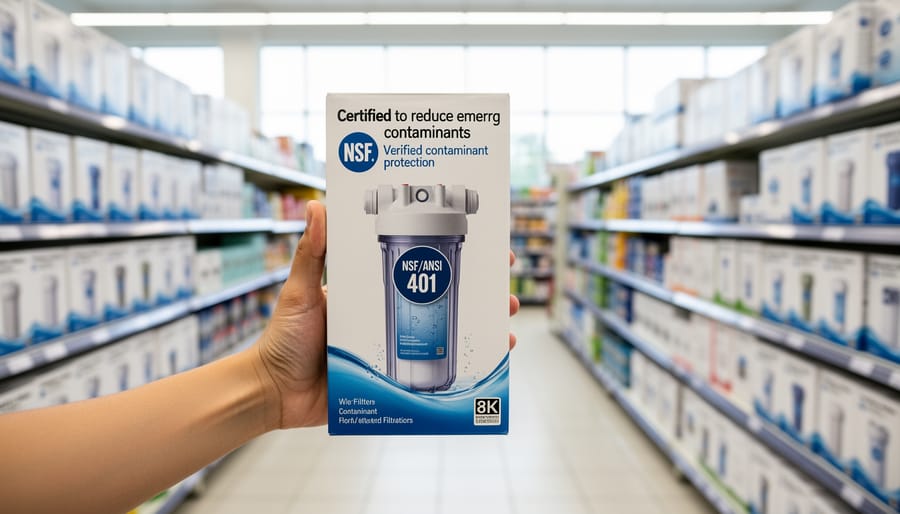
Start by checking the product packaging and labels for specific language. Look for phrases like “NSF/ANSI Standard 401 Certified” or “NSF Certified to Standard 401,” along with the NSF mark. Legitimate certifications will reference specific contaminant reduction claims rather than making blanket statements about water purity.
The most reliable verification method is visiting NSF International’s official website and using their product certification database. Simply search by brand name, model number, or filter type to access detailed certification information. This database shows exactly which contaminants each product removes and to what percentage, giving you transparency about what you’re buying.
Be wary of marketing red flags. Terms like “meets Standard 401 requirements” or “Standard 401 tested” without the word “certified” often indicate the product wasn’t independently verified by NSF or another accredited organization. Some companies conduct in-house testing but skip the rigorous third-party certification process.
You can also contact manufacturers directly to request certification documentation. Reputable companies readily provide certification numbers and supporting evidence. If a company hesitates or provides vague responses, consider that a warning sign. Taking these verification steps ensures your investment genuinely protects your family from emerging contaminants while supporting eco-conscious water treatment innovations.
The Environmental Impact of Choosing Standard 401 Certified Systems
Choosing NSF/ANSI Standard 401 certified water treatment systems creates positive ripple effects that extend far beyond your home. When your household water meets high purity standards, you’re making a meaningful contribution to environmental sustainability in several interconnected ways.
The most immediate environmental benefit comes from reducing bottled water consumption. Americans purchase billions of single-use plastic bottles annually, many seeking cleaner drinking water. By installing a certified filtration system that removes emerging contaminants, you eliminate the need for bottled water, cutting down on plastic waste that often ends up in landfills and oceans. This single switch can prevent hundreds of bottles per person from entering the waste stream each year.
Standard 401 certification also promotes responsible water stewardship at the household level. When your system effectively removes pharmaceuticals, herbicides, and other emerging contaminants, you’re preventing these substances from re-entering local water systems through household wastewater. This creates a cleaner water cycle for your community and reduces the burden on municipal treatment facilities.
Additionally, properly treated water means fewer harmful chemicals flowing into our ecosystems. Prescription medications and pesticides can accumulate in waterways, affecting aquatic life and disrupting natural habitats. By filtering these contaminants at home, you’re protecting local wildlife and maintaining healthier rivers, lakes, and streams.
Making informed choices about water treatment systems represents a practical step toward sustainable living. Standard 401 certification ensures you’re investing in technology that delivers both personal health benefits and environmental protection, aligning your daily water use with broader ecological responsibility.
Understanding NSF/ANSI Standard 401 empowers you to make informed decisions about your family’s water quality. In today’s world, where emerging contaminants like pharmaceuticals, pesticides, and personal care products increasingly appear in our water supply, this certification represents a crucial advancement in water safety technology. By choosing filtration systems that meet Standard 401, you’re taking a proactive step toward protecting your household from substances that traditional water treatment may miss.
Now is the perfect time to evaluate your current water filtration setup. Check whether your system carries NSF/ANSI Standard 401 certification, or consider upgrading to one that does. This simple assessment can make a significant difference in reducing your exposure to contaminants of emerging concern that affect both human health and the environment.
The peace of mind that comes with verified contaminant reduction cannot be overstated. When you see that NSF/ANSI certification mark, you’re not just purchasing a water filter—you’re investing in rigorously tested protection backed by independent verification. For environmentally-conscious homeowners committed to sustainable living and cutting-edge water innovations, Standard 401 compliance represents the gold standard in comprehensive water treatment for modern households.