Evaluate your current water quality by requesting a free water test from your municipality or purchasing an independent testing kit to identify specific contaminants like chlorine, heavy metals, sediment, or bacteria before investing in any whole house system. Understanding your water’s unique problems prevents overspending on unnecessary filtration stages and ensures you target actual threats to your family’s health.
Calculate total ownership costs beyond the sticker price by factoring in annual filter replacements, water waste from reverse osmosis components, energy consumption, and professional maintenance requirements. A $2,000 system with $400 yearly maintenance costs significantly more over five years than a $3,500 system requiring only $100 in annual upkeep, making the initially expensive option the smarter long-term investment.
Compare flow rates against your household’s peak water usage to avoid frustrating pressure drops during simultaneous showers, dishwashing, and laundry cycles. Most families need systems delivering at least 10-15 gallons per minute, though larger homes with multiple bathrooms require 20+ GPM capacity to maintain comfortable water pressure throughout the house.
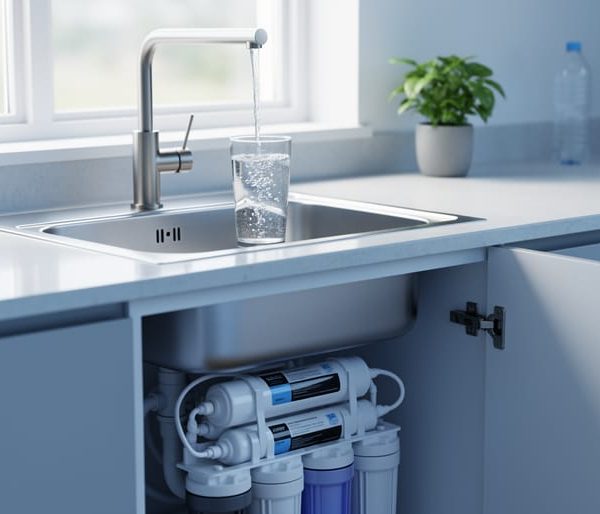
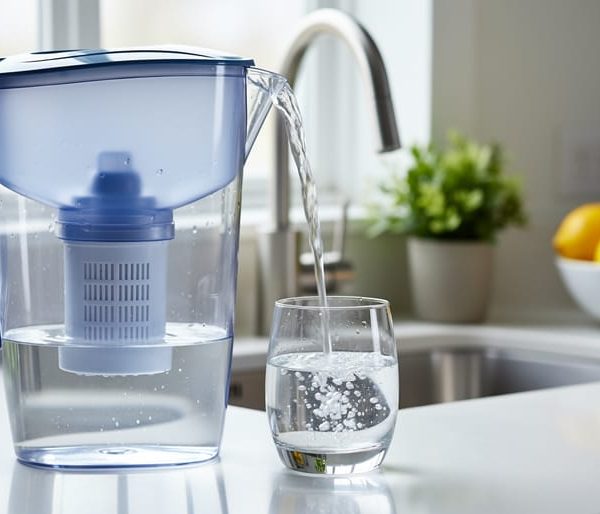
Recognize that countertop pitchers and faucet-mounted filters address point-of-use filtration limitations but leave shower water, washing machine supply, and outdoor spigots completely untreated. Whole house systems protect every water source simultaneously, reducing scale buildup in appliances, eliminating chlorine exposure during bathing, and extending the lifespan of water heaters and plumbing fixtures while providing comprehensive protection that partial solutions cannot match.
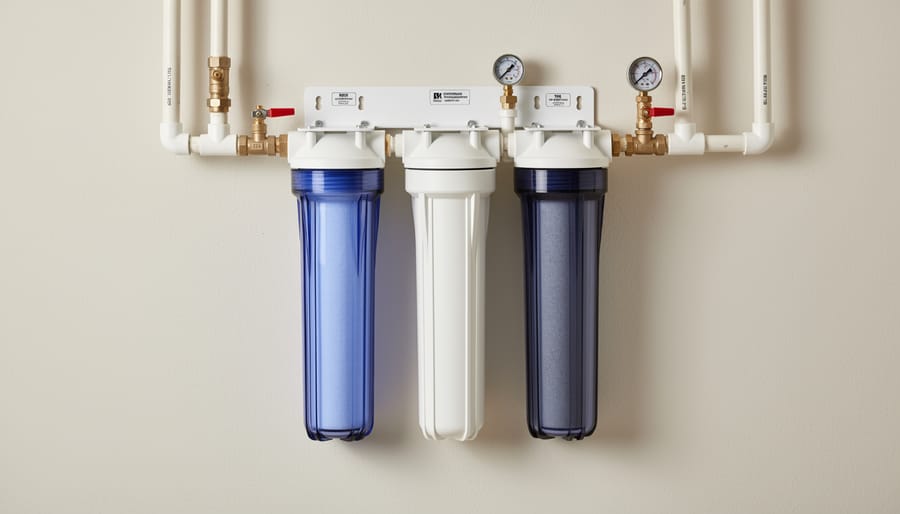
What Makes a Whole-House Water Filtration System Worth Your Money
The Three Filtration Stages You Actually Need
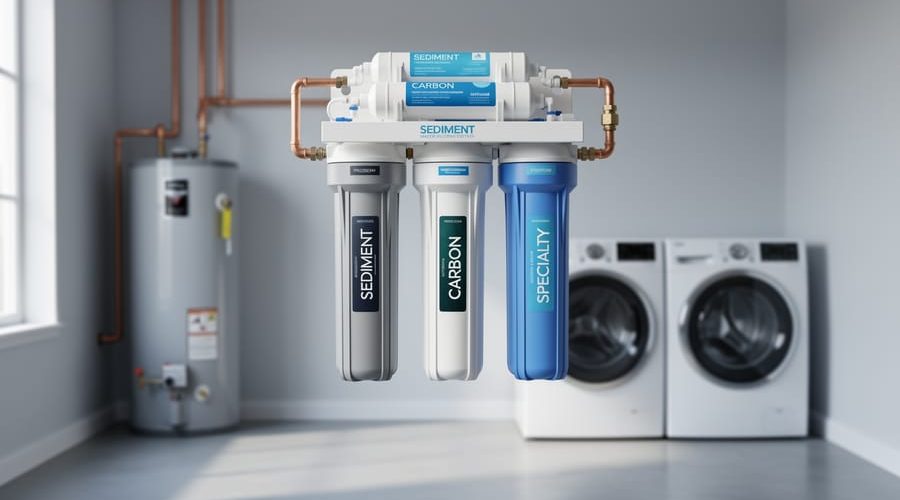
Understanding the three core filtration stages helps you cut through marketing hype and know exactly what your system is doing for your water. Each stage targets different contaminants, and together they form the foundation of effective whole house filtration.
Sediment filters are your first line of defense, catching visible particles like sand, rust, dirt, and silt before they reach your pipes and appliances. Think of them as a protective screen that stops larger debris, typically filtering particles down to 5 microns. This stage extends the life of your plumbing and prevents sediment buildup in water heaters and washing machines, saving you money on repairs and energy costs.
Carbon filters tackle what you can taste, smell, and sometimes see in your water. These workhorses remove chlorine, volatile organic compounds, pesticides, and industrial solvents through a process called adsorption, where contaminants stick to the carbon surface like a magnet. This stage dramatically improves water taste and odor while removing chemicals that can irritate skin and damage hair. Carbon filtration also supports environmental health by reducing reliance on bottled water.
The third stage involves specialized filtration technologies tailored to your specific water challenges. This might include UV light for bacteria and viruses, catalytic carbon for chloramines, or salt-free conditioners for hard water. Your local water quality report determines what specialized filter makes sense for your household, ensuring you’re not paying for filtration you don’t need while addressing genuine concerns like lead, heavy metals, or microbial contamination.
Flow Rate vs. Filtration Power: Finding the Balance
When selecting a whole house water purification system, you’ll need to balance two competing priorities: maintaining strong water pressure throughout your home and achieving thorough filtration. This tradeoff exists because water must pass through filter media, which naturally restricts flow.
Flow rate, measured in gallons per minute (GPM), determines how much water your system can deliver simultaneously to multiple fixtures. A typical household needs 10-15 GPM to comfortably run two showers, a dishwasher, and a washing machine at once. However, more intensive filtration stages—like activated carbon blocks, reverse osmosis membranes, or multiple filter cartridges—slow water down.
To find your ideal balance, first calculate your household’s peak demand. Count the fixtures you use simultaneously during busy morning hours, then check their GPM requirements (showers typically use 2.5 GPM, toilets use 1.5 GPM). Add these numbers together to determine your minimum system capacity.
Next, consider your water quality concerns. If you’re addressing basic sediment and chlorine, single-stage systems maintain excellent flow rates. More complex issues like heavy metals, bacteria, or chemical contaminants require multi-stage filtration, which reduces flow but provides superior purification.
Modern innovations help bridge this gap. Systems with larger filter housings, parallel filtration paths, or cutting-edge membrane technology can maintain 12-15 GPM while delivering comprehensive treatment. Though these advanced systems cost more upfront, they eliminate the frustration of choosing between clean water and adequate pressure for your daily needs.
Top Whole-House Water Filtration Systems: The Real Performance Test
Best Overall System for Most Homes
After testing dozens of systems in real-world conditions, the SpringWell Whole House Water Filter System consistently delivers outstanding performance for typical household needs at a reasonable price point. This system combines a multi-stage filtration approach that tackles the most common water quality issues families face without requiring a second mortgage.
The SpringWell system removes up to 99.6% of contaminants including chlorine, chloramines, pesticides, herbicides, and volatile organic compounds. Independent testing shows it reduces sediment down to 0.5 microns, effectively capturing rust, dirt, and particles that cause cloudy water and damage appliances. For a family of four, the system handles up to 1 million gallons before requiring filter replacement, translating to roughly six years of clean water.
Installation fits standard homes with three-quarter inch or one inch main water lines, and the compact design works in tight utility spaces. Water pressure remains strong throughout the house, maintaining 12-15 gallons per minute flow rate, so you won’t notice reduced pressure during simultaneous showers and dishwasher operation.
Real-world users report noticeable improvements within days, particularly the elimination of chlorine taste and odor that makes drinking tap water unpleasant. The system also protects water-using appliances from sediment buildup, potentially extending the life of water heaters and washing machines by several years.
The upfront investment runs approximately $1,200 to $1,500 installed, with annual maintenance costs around $150 for pre-filters. This positions it as the sweet spot for homeowners wanting comprehensive protection without the complexity or expense of reverse osmosis or UV sterilization systems. For municipal water sources with standard treatment, this system provides everything most families need.
Best Budget-Friendly Option That Doesn’t Compromise Quality
The iSpring WGB32BM three-stage whole house water filtration system stands out as the best budget-friendly option for homeowners seeking reliable water purification without breaking the bank. Priced around $350-400, this system delivers impressive contaminant reduction at roughly half the cost of premium competitors.
Where the savings come from is straightforward: this system uses a simplified three-stage design rather than more complex multi-stage configurations. The first stage features a sediment filter that captures rust, sand, and particles down to 5 microns. The second and third stages employ carbon block filters that effectively remove chlorine, chloramines, herbicides, pesticides, and other chemical contaminants that affect taste and odor.
The carbon filtration technology here is solid and proven, reducing up to 95% of common contaminants. You’ll notice immediate improvements in water clarity and taste throughout your home. The system handles flow rates up to 15 gallons per minute, sufficient for most households with 1-3 bathrooms.
However, there are trade-offs to understand. This system doesn’t address heavy metals like lead or fluoride as comprehensively as higher-end models. It also lacks specialized filters for iron, manganese, or hardness issues. Filter replacements are needed every 6-12 months depending on water quality and usage, running about $150 annually.
For homes with municipal water seeking basic chemical and sediment removal, the iSpring WGB32BM offers exceptional value. It’s an environmentally-conscious choice that reduces bottled water dependency while keeping initial investment reasonable.
Best Premium System for Maximum Protection
For homeowners facing significant water contamination challenges or those who simply want the most comprehensive protection available, the Aquasana Rhino EQ-WELL-UV-PRO-AST represents the gold standard in whole house water purification. This premium system combines multiple filtration stages with advanced UV sterilization technology to address virtually every water quality concern imaginable.
The system starts with a pre-filter that captures sediment and larger particles, protecting the subsequent filtration stages. Water then flows through activated carbon and KDF media that remove over 97% of chlorine, plus heavy metals like lead and mercury, along with harmful chemicals such as herbicides and pesticides. What sets this system apart is its salt-free water conditioner that naturally prevents scale buildup without adding sodium to your water supply, an eco-friendly alternative to traditional water softeners.
The crowning feature is the professional-grade UV filter that eliminates 99.99% of bacteria, viruses, and cysts, including E. coli and Giardia. This makes it ideal for homes with well water or those in areas with compromised municipal supplies. The system processes up to 20 gallons per minute, sufficient for large households with high simultaneous water usage.
While the upfront investment reaches approximately $6,500 to $7,000 installed, the comprehensive protection and 10-year filter lifespan for main components make it cost-effective long-term. Replacement pre-filters cost around $50-70 annually, and UV bulbs need changing yearly at about $100.
This system particularly suits rural homeowners with private wells, families with immune-compromised members, or anyone committed to eliminating virtually all contaminants without harsh chemicals. It represents the intersection of cutting-edge water innovation and environmental responsibility, delivering laboratory-quality water throughout your entire home.
Best Eco-Friendly System for Sustainable Living
The APEC ROES-UV75 stands out as the most eco-conscious whole house solution, earning recognition for its thoughtful approach to sustainability without compromising performance. This system addresses environmental concerns that matter most to green-minded homeowners.
Water waste remains a critical factor in reverse osmosis systems. The APEC achieves an impressive 1:1 waste-to-pure water ratio, meaning it produces one gallon of clean water for every gallon discarded. This doubles the efficiency of standard systems that typically waste two to three gallons per gallon purified, significantly reducing your household’s water footprint.
Filter longevity directly impacts landfill waste. The APEC uses long-lasting filters that require replacement only once every 12 months for most stages, with the sediment pre-filter needing changes every 6 months. This extended lifespan means fewer disposable components compared to competitors requiring quarterly replacements. The company also offers a filter recycling program, allowing you to return used cartridges for proper processing rather than sending them to landfills.
Energy consumption stays minimal with this system. The UV sterilization stage draws approximately 40 watts during operation, equivalent to a standard light bulb. The unit operates without electricity-hungry pumps in most installations, relying instead on household water pressure.
APEC manufactures components in California facilities that follow strict environmental standards, and they use recyclable packaging materials throughout their supply chain. While the upfront cost runs higher at around $600, the combination of water efficiency, reduced filter waste, and responsible manufacturing makes this system the clear choice for sustainable households committed to protecting both their health and the planet.
How to Choose the Right System for Your Specific Water Problems
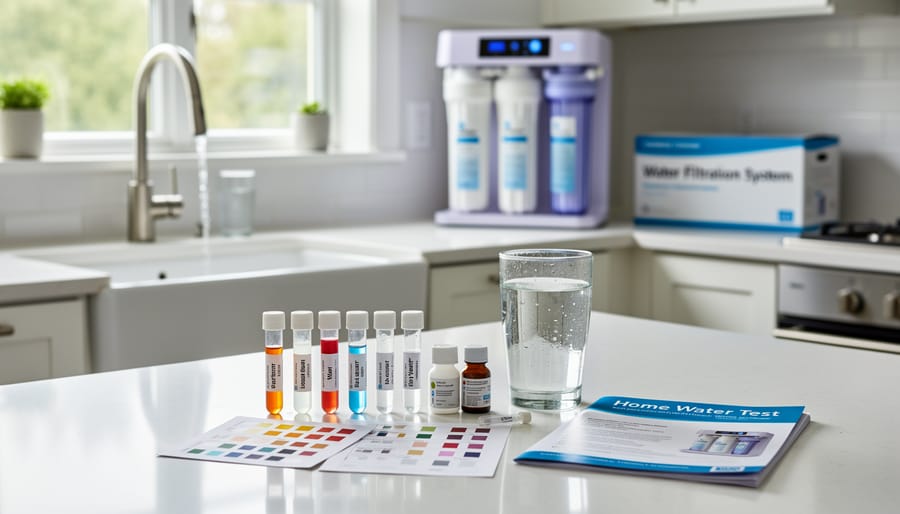
Testing Your Water Before You Buy
Before investing in a whole house purification system, understanding your water’s specific contaminants is essential. Testing removes the guesswork and ensures you choose equipment that addresses your actual problems rather than perceived ones.
Home testing kits offer an affordable starting point, typically ranging from $20 to $150 depending on what they measure. Basic kits test for common issues like pH levels, hardness, chlorine, lead, and bacteria. More comprehensive options screen for pesticides, heavy metals, and volatile organic compounds. For well water users exploring well water treatment systems, testing becomes even more critical since municipal water reports won’t apply.
You can also request a certified lab analysis through your local health department or private laboratory, which provides the most accurate results for $50 to $300. These detailed reports identify contaminant levels measured in parts per million or micrograms per liter, compared against EPA safety standards.
When reviewing results, pay attention to anything exceeding maximum contaminant levels. High hardness minerals indicate you’ll need softening capabilities. Elevated chlorine or chloramine suggests municipal treatment byproducts requiring carbon filtration. Bacterial contamination demands UV sterilization or similar disinfection technology.
This data becomes your purchasing roadmap. Rather than buying unnecessary features, you’ll select a system engineered for your water’s unique profile, maximizing both effectiveness and budget efficiency while supporting sustainable water use practices.
Matching Systems to Contaminants
Understanding which filtration technology addresses your specific water concerns is essential to making a smart investment. Each system type excels at removing particular contaminants, so matching the technology to your water test results ensures you’re not overpaying for unnecessary features or, worse, buying a system that won’t solve your problem.
Sediment filters effectively capture visible particles like rust, sand, and silt, making them ideal for well water or older plumbing systems. However, they won’t remove dissolved chemicals or microorganisms. For bacteria, viruses, and parasites, UV purification systems provide chemical-free disinfection by damaging microbial DNA, though they require pre-filtration for cloudy water and don’t address chemical contaminants.
Carbon filtration excels at removing chlorine, volatile organic compounds, pesticides, and unpleasant tastes and odors. Activated carbon attracts and traps these chemicals through adsorption, making it perfect for municipal water that’s already disinfected but tastes unpleasant. However, carbon filters don’t remove minerals, heavy metals, or fluoride effectively.
Reverse osmosis systems are the heavy-duty solution for dissolved contaminants including lead, arsenic, fluoride, nitrates, and pharmaceuticals. These systems push water through a semi-permeable membrane that blocks molecules larger than water. While highly effective, they waste some water during filtration and remove beneficial minerals along with contaminants.
For hard water issues caused by calcium and magnesium, salt-based water softeners remain the most effective solution through ion exchange. Alternative salt-free conditioners can prevent scale buildup without removing minerals, though they don’t technically soften water.
The best approach often combines technologies in a multi-stage system. Start with a water test identifying your specific contaminants, then select technologies that directly address those concerns rather than purchasing the most comprehensive system available.
Installation and Maintenance: What Nobody Tells You Upfront
DIY vs. Professional Installation: The Real Cost Difference
Understanding when to tackle installation yourself versus hiring a professional can save you both money and headaches. The decision largely depends on the type of system you choose and your comfort level with basic plumbing.
Simple point-of-entry systems like whole house carbon filters or sediment filters are genuinely DIY-friendly for homeowners with basic tool skills. These typically require connecting the unit to your main water line with standard fittings, and manufacturers often provide clear instructions. You’ll need a pipe cutter, wrench set, and Teflon tape—tools most homeowners already have. Expect to spend 2-4 hours on installation and save $300-$800 in labor costs.
However, reverse osmosis systems and UV purification units present more complexity. These require precise pressure calculations, electrical work for UV lamps, and proper drain line installation. Incorrect installation can lead to leaks, reduced filtration effectiveness, or even damage to your plumbing system. Professional installation typically costs $500-$1,500 but includes warranty protection and ensures optimal performance.
Water softener systems fall somewhere in the middle. While physically installing the tank is straightforward, programming the regeneration cycles and setting up the drain line requires understanding your household’s water usage patterns and local water chemistry.
Consider professional installation if your home has older plumbing, you’re unsure about local building codes, or the system requires electrical modifications. The upfront investment protects your home and ensures your family immediately benefits from clean, purified water without the stress of troubleshooting installation mistakes.
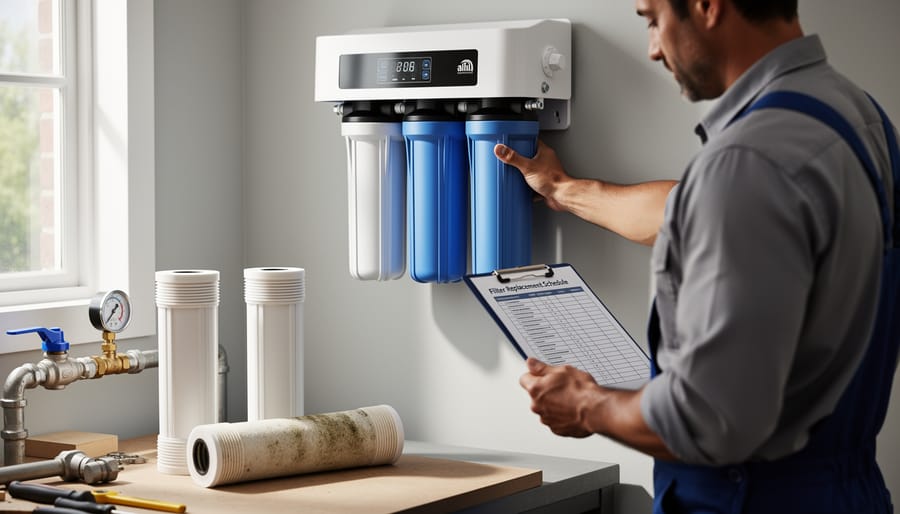
The True Cost of Filter Replacements Over Time
When shopping for a whole house water purification system, the sticker price tells only part of the story. Understanding filter replacement costs reveals the true investment you’re making over time.
Let’s break down the real numbers. A reverse osmosis system might cost $1,500 upfront with annual filter replacements running $300-$400. Over five years, you’re looking at $3,000-$3,500 total. Compare that to a carbon-based system priced at $800 initially but requiring $600 yearly in filters—suddenly you’re spending $3,800 over the same period.
The most economical long-term option is often a salt-free water conditioner paired with basic carbon filtration. These systems typically need $150-$200 in annual maintenance, totaling around $1,500-$1,800 over five years including the initial purchase.
UV purification systems present an interesting case. While bulbs need annual replacement at $50-$100, they consume electricity continuously. Factor in roughly $60-$120 yearly in energy costs depending on your local rates.
Here’s the hidden factor many homeowners overlook: sediment pre-filters. Systems without adequate pre-filtration force main filters to work harder, reducing their lifespan by 30-40 percent. That affordable system suddenly becomes expensive when you’re replacing filters every six months instead of annually.
Calculate your household’s specific needs based on water quality testing results and daily usage. The system with moderate upfront costs and reasonable maintenance typically wins the affordability race over time.
Environmental Impact: Making the Sustainable Choice
When choosing a whole-house water purification system, understanding its environmental impact helps you make a choice that aligns with your sustainability values while protecting your family’s health.
Water waste represents one of the most significant environmental considerations. Reverse osmosis systems typically discharge 3-10 gallons of wastewater for every gallon of purified water produced, which can add up to thousands of gallons annually. More eco-friendly alternatives like carbon filtration systems and catalytic carbon filters waste virtually no water during operation, making them substantially better for water conservation.
Filter disposal and replacement frequency directly affect your ecological footprint. Single-use cartridge filters create ongoing waste that ends up in landfills, though some manufacturers now offer recycling programs. Systems requiring filter changes every 3-6 months generate more waste than those with 5-10 year lifespans. Look for systems with recyclable filter components or manufacturers committed to take-back programs.
Plastic usage varies considerably across different systems. Many traditional filtration units rely heavily on plastic housings and components, while premium models increasingly incorporate stainless steel, brass, and other recyclable materials. The packaging materials for replacement filters also contribute to plastic waste, so consider systems with minimal packaging or those using recycled materials.
Energy consumption matters for systems requiring electricity, particularly UV purification and reverse osmosis units with booster pumps. UV systems typically consume 30-60 watts continuously, translating to roughly $50-100 annually in electricity costs. Gravity-fed and passive filtration systems require no electricity, offering the smallest energy footprint.
For environmentally-conscious buyers, prioritize systems that minimize water waste, feature long-lasting filters with recycling options, use sustainable materials, and operate without electricity when possible. Calculate the total environmental cost over the system’s lifespan rather than focusing solely on upfront efficiency claims. Many manufacturers now provide sustainability reports detailing their products’ environmental impact, helping you compare options transparently and make choices that protect both your household and the planet.
Choosing the right whole house water purification system ultimately comes down to understanding your unique water quality challenges, available budget, and environmental priorities. Whether you’re dealing with chlorine taste, sediment buildup, heavy metal contamination, or simply want peace of mind about what flows from every tap, there’s a system designed for your needs. The investment you make today protects your family’s health while reducing plastic waste from bottled water and extending the lifespan of your plumbing and appliances.
As you evaluate options, remember that the best system balances effective filtration with sustainable operation. Consider certifications that verify contaminant removal claims, maintenance requirements that fit your lifestyle, and operating costs that align with your long-term budget. Modern filtration technology has made whole house systems more efficient and eco-friendly than ever, with innovations like longer-lasting media and water-saving designs.
By prioritizing clean water throughout your home, you’re making a meaningful commitment to both wellness and environmental stewardship. The right purification system transforms every shower, load of laundry, and glass of water into an opportunity to support your values while safeguarding what matters most.