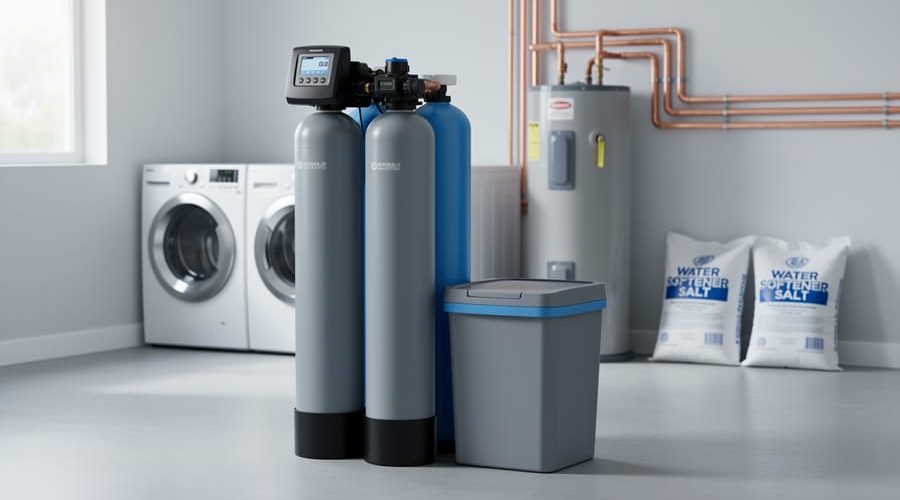
Multiply your household size by 75 gallons to estimate daily water consumption, then test your water hardness in grains per gallon (gpg) using an at-home kit or municipal water report. Calculate your daily softening requirement by multiplying daily water usage by hardness level—a family of four using 300 gallons daily with 10 gpg hardness needs a system handling 3,000 grains per day. Choose a water softener with a capacity 20-25% higher than your calculated requirement to account for regeneration cycles and occasional peak usage, ensuring your system operates efficiently without constant regeneration that wastes water and salt.
Understanding proper sizing prevents two costly mistakes: undersized units that regenerate too frequently, driving up water and salt consumption while shortening equipment lifespan, and oversized systems that sit stagnant between cycles, potentially harboring bacteria and wasting your initial investment. The right calculation considers not just current needs but future changes—additional household members, new appliances, or seasonal variations in water use.
Modern water softener sizing goes beyond simple formulas. Factor in your regeneration preference (time-initiated versus demand-initiated), peak flow rate requirements for simultaneous water use, and your environmental priorities. Demand-initiated systems adjust to actual usage patterns, reducing unnecessary regeneration and aligning with sustainable household management. For homes with variable occupancy or those committed to minimizing their environmental footprint, this technology-driven approach offers both performance and responsibility.
Getting the calculation right from the start means decades of soft water benefits without the inefficiency of an ill-matched system—protecting your plumbing, reducing cleaning product usage, and supporting long-term water conservation goals.
Why Water Softener Size Actually Matters
The Cost of Getting It Wrong
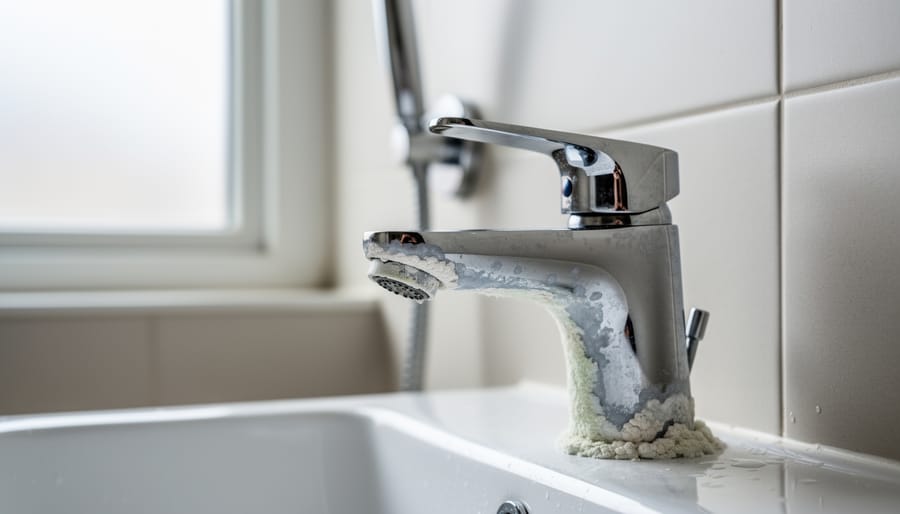
Choosing the wrong size water softener isn’t just an inconvenience—it’s a drain on your wallet and the environment. When your system is oversized, it regenerates more frequently than necessary, wasting both water and salt. Each regeneration cycle can use 50-100 gallons of water, meaning an improperly sized unit might waste thousands of gallons annually. That’s water literally going down the drain, along with the salt and energy required to heat it.
An undersized system creates different but equally costly problems. Running constant regeneration cycles to keep up with demand shortens your system lifespan dramatically, potentially cutting years off equipment that should last 15-20 years with proper sizing. You’ll also experience hard water breakthrough between cycles, defeating the entire purpose of softening and causing scale buildup in your pipes and appliances.
The financial impact adds up quickly. Beyond wasted water and salt, premature equipment replacement can cost $400-$2,500 depending on your system. Meanwhile, hard water damage to water heaters, dishwashers, and plumbing fixtures creates hidden costs that homeowners often don’t connect to their softener sizing mistake.
From an environmental perspective, excess regeneration cycles mean more salt entering wastewater systems and unnecessary freshwater consumption. Getting the sizing right the first time protects both your budget and local water resources—a win-win that starts with accurate calculations.
What ‘Capacity’ Really Means
When shopping for a water softener, you’ll see capacity measured in grains—but what does that actually mean? This number represents how many grains of hardness minerals (primarily calcium and magnesium) the system can remove before it needs to regenerate or refresh itself.
Think of grain capacity like a sponge’s absorption limit. A 32,000-grain softener can absorb 32,000 grains of hardness before it’s saturated and must flush out those collected minerals. The higher the capacity, the longer your system can operate between regeneration cycles.
Here’s where it gets practical: manufacturers often advertise peak capacity numbers, but real-world efficiency typically runs at about 70-80% of that maximum. A system rated for 40,000 grains might effectively handle around 30,000 grains in everyday use.
Understanding capacity helps you match your household’s actual water consumption and hardness levels to the right equipment size. Too small, and your softener regenerates constantly, wasting water and salt. Too large, and you’re paying for unused capacity while water sits stagnant in an oversized tank. Getting this measurement right means efficient operation, lower running costs, and reduced environmental impact—a win for both your wallet and sustainable living goals.
The Essential Numbers You Need to Know
Your Water Hardness Level
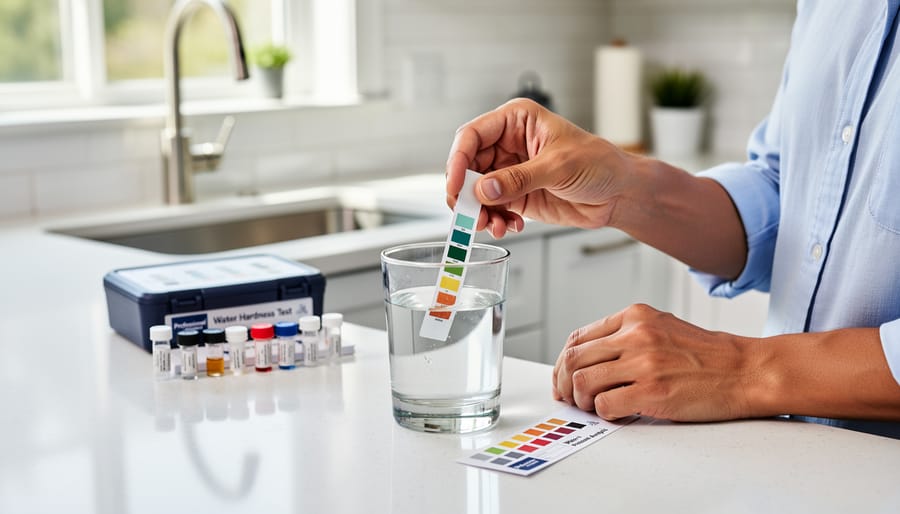
Before you can properly size your water softener, you need to know your water’s hardness level. This measurement indicates the concentration of dissolved minerals—primarily calcium and magnesium—in your water supply. Hardness is typically measured in grains per gallon (gpg) or parts per million (ppm), with 1 gpg equaling approximately 17.1 ppm.
The easiest way to find your hardness level is to check your municipal water quality report, often called a Consumer Confidence Report. Your local water utility provides this annually and usually posts it online. Look for entries labeled “hardness,” “calcium,” or “total dissolved solids.”
If your report doesn’t include hardness data or you have well water, home testing is your next option. You can purchase affordable test strips at hardware stores that provide results within minutes. For more accurate readings, consider mail-in laboratory tests or digital meters, which typically cost between $15 and $50.
Water hardness classifications range from soft (0-3.5 gpg) to very hard (over 10.5 gpg). Most households requiring softeners fall between 7-15 gpg. Understanding your specific number ensures you select a system that effectively treats your water without oversizing, which wastes both resources and money while contradicting sustainable living principles.
Daily Water Consumption
Understanding your household’s daily water consumption is the foundation for properly sizing a water softener. The standard guideline estimates that each person uses between 75-100 gallons of water per day. This includes everything from morning showers and toilet flushes to dishwashing and laundry. For a typical family of four, you’re looking at roughly 300-400 gallons daily.
To calculate your household’s consumption, start by multiplying the number of people in your home by 80 gallons (a middle-ground estimate). A family of three would use approximately 240 gallons per day, while a household of five would consume around 400 gallons daily.
Want a more accurate picture? Check your water bills. Most utility companies list monthly consumption in gallons or cubic feet. Divide your monthly usage by 30 to get your average daily consumption. This method accounts for your family’s unique habits—whether you’re frequent clothes washers, long shower-takers, or water-conserving champions.
Keep in mind that larger households or those with high-efficiency appliances may deviate from standard estimates. If you’ve recently installed low-flow fixtures or adopted water-saving practices, your actual consumption might be pleasantly lower than the 75-100 gallon guideline suggests. Knowing this number ensures you select a water softener that matches your real-world needs without wasting resources or money.
Iron and Manganese Adjustments
While water hardness from calcium and magnesium gets most of the attention, iron and manganese also impact your softener sizing calculations. These minerals contribute to water hardness and can damage your softener resin if not properly accounted for.
Iron appears in two forms: dissolved (ferrous) iron, which is invisible, and oxidized (ferric) iron, which causes rust-colored staining. Manganese creates black or brown stains. Both minerals act like hardness minerals during the softening process, meaning they occupy space on the resin beads alongside calcium and magnesium.
Here’s the conversion formula: multiply your iron concentration by 4 and your manganese concentration by 4, then add these values to your water hardness measurement. For example, if you have 15 grains per gallon (gpg) hardness plus 2 parts per million (ppm) iron, your adjusted hardness becomes 23 gpg (15 + 8). This adjustment ensures your water softener has adequate capacity to handle all problem minerals, protecting your investment while delivering truly soft water throughout your home. Testing for these minerals during your water quality assessment helps you size correctly from the start.
Number of Household Members
The number of people in your household directly determines your daily water consumption, which is the foundation of proper water softener sizing. Industry standards estimate that each person uses approximately 75-100 gallons of water per day for activities like showering, washing dishes, doing laundry, and cooking. A family of four would therefore consume between 300-400 gallons daily, requiring a significantly larger capacity softener than a single-person household.
When calculating your needs, think beyond your current situation. If you’re planning to expand your family or frequently host guests for extended periods, factor in these additional users to avoid undersizing your system. Installing a slightly larger capacity softener now prevents the inconvenience and expense of upgrading later. However, oversizing too much can reduce efficiency and increase your environmental footprint through unnecessary salt and water waste during regeneration cycles. The sweet spot balances your realistic maximum occupancy with sustainable operation, ensuring your water softener handles peak demand while maintaining eco-friendly performance throughout its lifespan.
How the Water Softener Sizing Calculator Works
The Basic Sizing Formula Explained
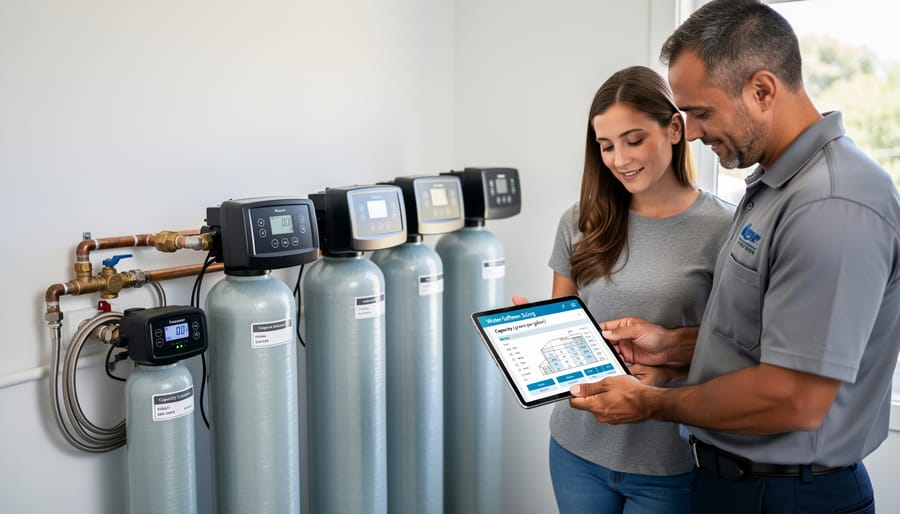
Calculating the right water softener size doesn’t require advanced mathematics. The basic formula multiplies four straightforward factors: your water hardness level, daily water consumption per person, number of household members, and days between regeneration cycles.
Here’s how it works: Hardness (in grains per gallon) × Daily Water Use (in gallons) × Number of People × Days Between Regeneration = Required Capacity (in grains)
Let’s walk through a practical example. Imagine your household has water with a hardness level of 10 grains per gallon, which is moderately hard. The average person uses about 75 gallons of water daily for showering, cooking, cleaning, and drinking. Your family has four members, and you’d prefer your system to regenerate every seven days to balance efficiency with salt consumption.
The calculation looks like this: 10 × 75 × 4 × 7 = 21,000 grains
This means you’d need a water softener with at least a 21,000-grain capacity. Many homeowners choose a system slightly larger than this minimum to accommodate occasional guests or higher water usage days.
Understanding this formula empowers you to make informed decisions rather than relying solely on sales recommendations. It also helps you balance performance with environmental considerations, since properly sized systems use salt and water more efficiently during regeneration cycles, reducing your household’s ecological footprint while ensuring consistently soft water.
Understanding Regeneration Frequency
Regeneration frequency refers to how often your water softener cleans itself by flushing out accumulated minerals. Most systems regenerate every 3-7 days, but the ideal schedule depends on your household’s water usage and hardness levels. Getting this timing right is crucial for both performance and sustainability.
Systems that regenerate too frequently waste salt and water, increasing your environmental footprint and operating costs. However, waiting too long between cycles means your softener runs out of capacity, allowing hard water to flow through your home and potentially damaging appliances.
Modern demand-initiated regeneration systems monitor actual water usage and trigger cleaning only when needed, typically after processing a predetermined number of gallons. This smart approach can save up to 30% on salt consumption compared to timer-based models that regenerate on a fixed schedule regardless of usage.
When calculating your softener size, consider that higher-capacity units regenerate less frequently, reducing resource consumption. A properly sized system for a family of four typically regenerates every 4-5 days, balancing efficiency with convenience. Understanding this relationship helps you choose equipment that meets your needs while minimizing environmental impact and operational expenses.
Adding a Safety Buffer
While your calculated water softener size provides a solid baseline, water treatment experts consistently recommend adding a safety buffer of 20-30% extra capacity. This cushion accounts for real-world usage fluctuations that your baseline calculations might miss—like hosting houseguests, seasonal laundry increases, or filling a backyard pool. Without this buffer, your softener may run multiple regeneration cycles per day during peak usage, which wastes water and salt while reducing the system’s lifespan.
From an eco-conscious perspective, this extra capacity actually promotes sustainability. A properly buffered system regenerates less frequently, conserving both water and resources over time. For example, if your calculation suggests a 32,000-grain softener, opting for a 40,000-grain unit provides breathing room that prevents system strain. This approach ensures consistent soft water delivery while protecting your investment and minimizing environmental impact through efficient operation.
Using Online Calculators vs. Manual Calculations
What Good Calculators Include
Not all water softener sizing calculators are created equal. The best tools go beyond basic hardness and household size, incorporating features that ensure your system matches your home’s unique needs while avoiding unnecessary waste.
Look for calculators that account for iron compensation. Even small amounts of dissolved iron increase your softening requirements—most experts recommend adding 3-4 grains per gallon of hardness for each part per million of iron present. Without this adjustment, you might end up with an undersized system that can’t handle your water chemistry.
Efficiency ratings matter too. Modern calculators should factor in the softener’s salt efficiency, measured in grains of hardness removed per pound of salt used. Systems range from 2,000 to 6,000 grains per pound, significantly impacting your ongoing costs and environmental footprint.
The most helpful calculators also include customizable regeneration schedules. You’ll want to input whether you prefer time-based cycles or on-demand regeneration, as this affects both sizing requirements and water conservation. Systems that regenerate only when needed typically save 20-40% more water and salt compared to fixed-schedule models, reducing your household’s environmental impact while lowering operating costs.
When to Do the Math Yourself
While online calculators offer convenience, some situations call for rolling up your sleeves and doing the math manually. If your household has unique circumstances—like multiple bathrooms with varying usage patterns, seasonal occupancy changes, or specific water quality concerns—a personalized calculation gives you greater control over accuracy.
Manual calculations are particularly valuable when you’re considering salt-free water softener systems or specialty filtration setups that don’t fit standard sizing charts. You might also prefer the hands-on approach if you have well water with fluctuating hardness levels throughout the year, requiring seasonal adjustments to your capacity needs.
Doing your own calculations helps you understand exactly how your household uses water and where you might reduce consumption for environmental benefits. This deeper knowledge empowers you to make informed decisions about capacity, regeneration frequency, and long-term efficiency. Additionally, if you’re working with a professional installer who recommends an unexpectedly large system, having your own calculations provides a helpful reference point for discussions. Taking time to understand the math ensures you invest in equipment that truly matches your needs rather than relying solely on generalized recommendations.
Real-World Sizing Examples
Small Household (1-2 People)
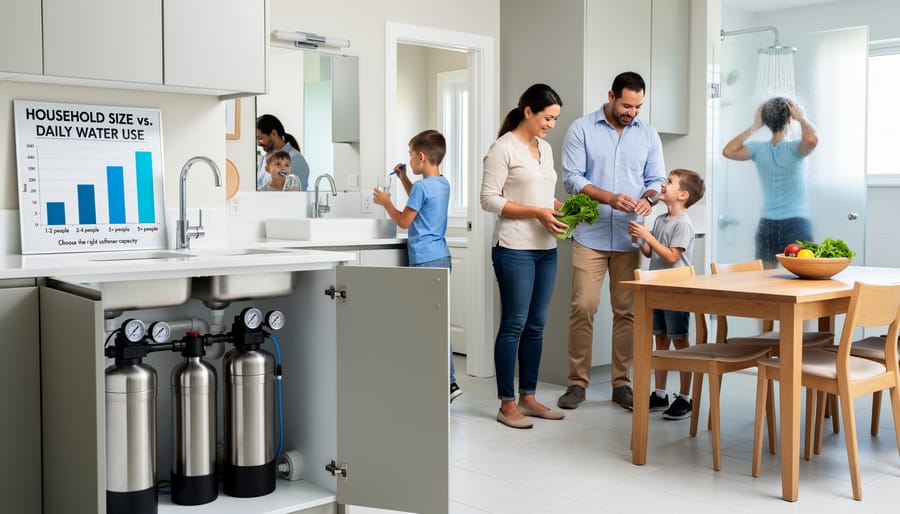
Let’s walk through a real-world example for a couple living in a typical apartment or small home. Imagine Sarah and Tom, who use approximately 80 gallons of water daily combined. Their municipal water report shows a hardness level of 10 grains per gallon (GPG), which is considered moderately hard.
To calculate their daily softening requirement, multiply the water usage by hardness level: 80 gallons times 10 GPG equals 800 grains of hardness that need removing each day. For weekly capacity, multiply by seven days, giving you 5,600 grains per week.
When shopping for a water softener, you’ll want a system rated for at least 6,000 to 8,000 grains of capacity to allow for buffer room. This modest-sized unit typically regenerates once weekly, using less salt and water than oversized systems—a win for both your wallet and the environment.
Compact households benefit from right-sized equipment that doesn’t waste resources during regeneration cycles. A properly calculated system means fewer chemicals entering wastewater and reduced environmental impact while still enjoying soft water for healthier skin, cleaner dishes, and longer-lasting appliances.
Average Family (3-4 People)
For a family of three to four people, your water softener sizing calculation starts with understanding your daily water consumption. The average household in this range uses approximately 300-400 gallons per day, though this varies based on lifestyle habits like laundry frequency and shower duration.
To determine your ideal softener capacity, multiply your daily water usage by your water’s hardness level. For example, if your family uses 350 gallons daily and your water tests at 10 grains per gallon hardness, you’ll need a softener that handles 3,500 grains daily (350 x 10 = 3,500).
Most professionals recommend sizing for 7-10 days between regeneration cycles to maximize efficiency and minimize water waste. Using our example, multiply 3,500 by 7 days, requiring a 24,500-grain capacity system. Rounding up to the nearest standard size, a 32,000-grain softener would serve your household well.
This sizing sweet spot ensures your system operates efficiently without frequent regeneration cycles, which conserves both salt and water—an important consideration for eco-conscious homeowners. Properly sized systems also extend equipment lifespan and reduce maintenance needs over time.
Large Household with High Iron Content
Meet the Rodriguez family: seven people in their household producing around 700 gallons of daily water use. Their well water tests at 15 grains per gallon of hardness, but here’s the complication—it also contains 8 PPM (parts per million) of iron.
Here’s what makes this calculation different: iron affects softener performance and must be factored into your sizing. The practical rule is to add 3 grains of hardness for every 1 PPM of iron. So their adjusted hardness becomes 15 + (8 × 3) = 39 grains per gallon.
Their daily softening requirement jumps to 700 gallons × 39 grains = 27,300 grains. With a standard 10-day regeneration cycle, they need 273,000 grains of capacity—pointing them toward a 32,000 to 40,000-grain system.
This example shows why water testing matters before sizing. Overlooking iron content would lead to undersizing, causing frequent regenerations, wasted salt, increased water consumption, and frustrated homeowners. Professional water testing ensures you capture all quality issues affecting your softener selection.
Environmental Considerations in Sizing Decisions
Salt Efficiency and Watershed Health
Choosing the right-sized water softener creates meaningful environmental benefits by optimizing salt efficiency. When a system matches your household’s actual hardness removal needs, it uses only the necessary amount of water softener salt during each regeneration cycle. Oversized units waste salt by regenerating more resin than needed, while undersized systems require more frequent regeneration, both scenarios dumping excess sodium chloride into wastewater systems.
This matters because the brine discharged during regeneration eventually reaches municipal treatment plants and natural waterways. When communities collectively use properly sized softeners, the cumulative reduction in salt discharge helps protect local watersheds and aquatic ecosystems. Sodium chloride can harm freshwater organisms and increase salinity levels in streams and groundwater supplies.
A correctly calculated system typically uses 30-50% less salt annually compared to an improperly sized unit. This translates to fewer salt bags purchased, reduced plastic packaging waste, and lower environmental impact. By using a sizing calculator to determine your precise needs based on water hardness, daily usage, and household size, you’re making an eco-conscious choice that benefits both your wallet and the environment around you.
Water Conservation Through Smart Sizing
Getting your water softener size right isn’t just about performance—it’s a powerful way to protect our planet’s most precious resource. When you accurately calculate your household’s water softening needs, you prevent your system from regenerating more frequently than necessary, which directly translates to significant water savings.
Oversized softeners seem like a safe choice, but they actually waste water by running regeneration cycles before they’re truly needed. Conversely, undersized units regenerate too often because they quickly exhaust their capacity, leading to excessive water consumption and increased salt usage. Think of it this way: a properly sized system regenerates only when its resin bed is saturated with hard water minerals, maximizing efficiency between cycles.
The environmental impact adds up quickly. An incorrectly sized softener can waste thousands of gallons annually through premature regeneration. By using a sizing calculator to match your system to your actual daily water consumption and hardness levels, you’re making a choice that benefits both your wallet and the environment. This smart approach to capacity planning embodies the principles of sustainable living—using resources thoughtfully without compromising on the water quality your family deserves.
Common Sizing Mistakes to Avoid
Relying Only on Household Size
Many homeowners make the mistake of choosing a water softener based solely on how many people live in their house. While household size matters, this approach overlooks two critical factors: your actual water consumption patterns and your water’s hardness level. A family of four that takes long showers daily uses far more water than a similar-sized household with shorter bathing habits. Similarly, water with 15 grains per gallon of hardness requires significantly more softening capacity than water measuring 5 grains per gallon. Relying on generic household size recommendations often results in purchasing an undersized system that regenerates too frequently, wasting water and salt, or an oversized unit that cycles inefficiently and costs more upfront. These sizing errors undermine both your budget and environmental goals. To choose the right system, you need to calculate based on your specific daily water usage multiplied by your water’s actual hardness level, ensuring the softener matches your household’s unique needs rather than a one-size-fits-all estimate.
Ignoring Future Needs
When sizing your water softener, it’s tempting to focus solely on current needs, but this short-sighted approach can lead to costly mistakes. Consider where your household might be in five years. Are you planning to expand your family? Thinking about adding a bathroom or installing water-intensive appliances like a second washing machine? These changes significantly impact your daily water consumption and hardness removal requirements.
A properly sized system should accommodate reasonable growth without requiring premature replacement. For example, a young couple might currently use 50 gallons per person daily, but adding children could increase household consumption by 30-40% within a few years. Similarly, lifestyle shifts like working from home or starting a garden irrigation system affect water usage patterns.
Building in a modest capacity buffer—typically 20-30% above current needs—provides flexibility for future changes while maintaining efficiency. This forward-thinking approach supports both your household’s evolution and environmental responsibility by preventing the waste associated with replacing undersized units.
Overlooking System Efficiency Ratings
When calculating your water softener needs, traditional sizing formulas often assume older, less efficient technology. Modern high-efficiency systems use 30-50% less salt and water during regeneration cycles, which fundamentally changes capacity requirements. These advanced models feature demand-initiated regeneration that monitors actual water usage rather than operating on fixed schedules, meaning they work smarter, not harder. If you’re comparing older calculators or recommendations, you might end up oversizing your system—paying more upfront and using unnecessary resources. When sizing your softener, ask specifically about efficiency ratings and regeneration frequency. A high-efficiency unit rated at 32,000 grains might effectively perform like a 40,000-grain traditional model due to reduced waste and optimized operation. This matters both for your wallet and environmental impact, as right-sizing an efficient system reduces salt discharge into water systems while maintaining perfect water quality.
Taking Your Calculations to the Next Step
Questions to Ask Installers
Armed with your calculated numbers, you’re ready to have productive conversations with water treatment professionals. Start by sharing your household’s daily water usage and current hardness level—this shows you’ve done your homework. Ask installers to explain how they arrived at their capacity recommendations and whether they factor in peak usage times, like busy mornings when multiple family members shower.
Request information about the system’s salt efficiency and regeneration frequency. A quality installer should explain how often the softener will regenerate based on your specific usage patterns, which directly impacts both operational costs and environmental footprint. Inquire about whether they recommend a meter-based or timer-based regeneration system—meter-based options typically waste less water and salt.
Don’t hesitate to ask about the system’s expected lifespan and warranty coverage. Question whether the proposed unit can accommodate future household changes, such as additional family members or increased water needs. Finally, request a breakdown of operating costs, including projected salt and water usage during regeneration cycles. Professionals who provide transparent, detailed answers demonstrate expertise and help you make an environmentally responsible choice that matches your household’s actual needs.
Matching Capacity to Available Systems
Once you’ve calculated your ideal softener capacity, you’ll need to match it to actual products available on the market. Modern water softener systems typically come in standard capacity increments like 32,000, 48,000, or 64,000 grains. If your calculation shows you need 38,000 grains, for example, you’d round up to the next available size—in this case, 48,000 grains.
Choosing a slightly larger capacity than your minimum requirement offers practical advantages. It provides a buffer for occasional guests, reduces regeneration frequency (saving water and salt), and extends the system’s lifespan by avoiding constant maximum-capacity operation. However, oversizing significantly can waste resources during regeneration cycles. Aim for a unit that’s 10-20 percent above your calculated needs for the sweet spot between efficiency and reliability. This approach balances performance with environmental responsibility while ensuring consistent soft water for your household.
Choosing the right water softener size is more than a purchasing decision—it’s an investment in your home’s plumbing infrastructure and a commitment to responsible water use. Properly sized systems prevent wasteful salt and water consumption during regeneration cycles, reducing your environmental footprint while protecting appliances and fixtures from scale buildup.
Think of sizing calculators as valuable starting points in your research journey. They provide the foundational numbers you need, but remember to consider your household’s unique patterns—whether you’re running multiple loads of laundry on weekends or have fluctuating occupancy throughout the year. These real-world factors matter just as much as the mathematical formulas.
By taking time to understand the calculations and evaluate your specific needs, you’re making an informed choice that balances performance, efficiency, and sustainability. A correctly sized water softener means fewer chemicals entering wastewater systems, lower energy consumption, and extended equipment lifespan—all contributing to a healthier home and planet. Your due diligence today creates lasting benefits for both your household budget and environmental resources tomorrow.